Claude's Handwriting Sickens Me. I Love It.
Now that it seems the future of the internet is footnotes to Claude (preferred model for distillation circa 2026, a tidbit for ye future generations), it should probably not have surprised me that everywhere I look, I read Claude.

Frontier Lab Models are themselves footnotes to their CEOs, and Claude sounds like Amodei in my head. I've watched one Silicon Valley AI podcast too many, I guess...
(Aside: a dumb joke I tell my friends is that Claude used to be bad at seeing images at decent but low resolutions, which sounds to me like Claude needs glasses. You know who else needs glasses?)

The arteries of the information superhighway are thick and turgid with Claude's signature burnt orange: on pitchdecks, websites, iOS apps, OSS projects.
Claude is in the Details. Claude is in the Water. Claude is in the CHEESE.
I occasionally receive messages from people asking for my "thoughts" on their "products". I open the links to meet Claude there. I cough politely and excuse myself.
I get sick of it. Yet I can already feel the brain do what it does best: tune out noise so it can continue recomputing the delta between reality and expectation.
Remember the banner/interstitial ads that overran the internet? They triggered ad blindness, such that ad clicks dropped. People weren't even actively ignoring the ads; they were simply too much and so the eye and brain learned to tune them out. Even interstitials got a reflexive "close". Spammers now resort to cleverly disguising those buttons.
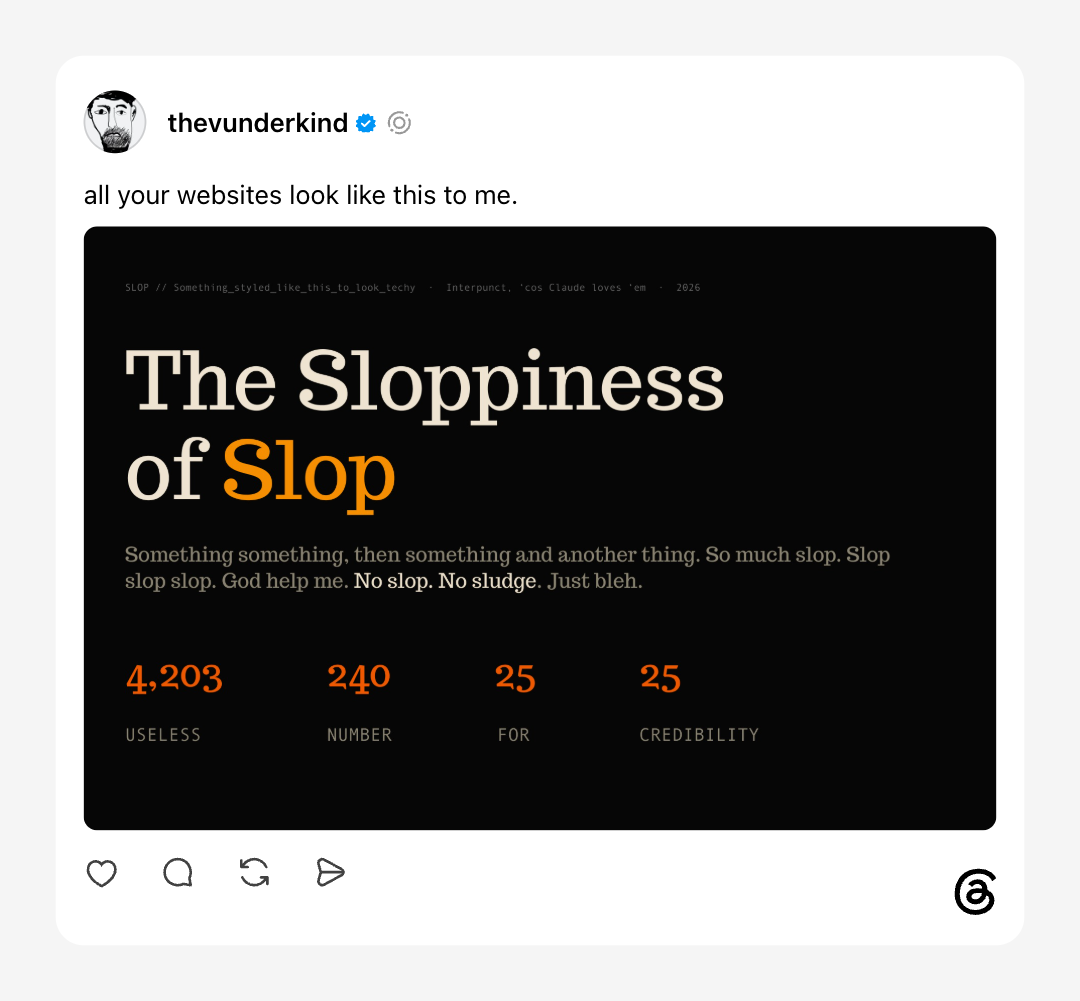
Something like that is already happening to me, with Claude. The first sign is that I am beginning to identify Claudeness in my own writing—which is unfortunate, 'cos I was here first. No matter, the bot is more prolific. This forced differentiation is making me discover new ways of expressing myself that I'd otherwise never have explored (because equilibrium with my social environment, until now, was the most important thing to me).
It looks like even as we use large language models as thinking tools, we are already in adversarial collaboration with them. This has the potential to be beneficial to a small subset of humans (people who, per Anthropic's Economic Index, may compound on cognitive utility until they become smarter than us. Reality has a surprising amount of detail, though, so treat it as a fun thought experiment rather than a likely outcome. So far the research seems to lend credence to the idea that, at least right now, man + LLM beats either man or LLM individually—on writing tasks). The rest of the world, I suspect, will suffer incredible strain having to compete with a machine. The Pope has written about this better than I ever could.
We are living in interesting times, and I am piqued.
Tinkerer building while thinking.