November’s Lessons on The Mainland Show
How we have been thinking — about the show
For a long time [until I, mostly by accident, started having friends/colleagues with near-obssessive focus on metaconsiderations) I wasn’t sure how much thinking was just enough and how much was overthinking. The good news: for most things, there is no such thing as overthinking. The bad news: analysis paralysis is a beast you have to slay every waking moment.
In November, I wrapped up a lot of my consumption for the better part of the year. Having shifted my focus somewhat from digital marketing [which, I must admit, holds fewer and fewer intrigues for me as the days roll by] to animation [as well as animation production], I found myself embarrassingly blank on a number of things, mostly in the department of history, pop culture, production, people management, and — sigh — structured creativity.
It took me a lot of time to conquer my natural resistances — my mind’s arthritic bones creaked in protest at the idea of learning so many new things at once, and with very few people [whom I knew personally] to run the race with, I couldn’t count on externalization to put me in a virtuous cycle, a feedback loop of encouragement.
In the first quarter of the year, I sought to fix that problem. I hit up some of the creative people with whom I had already established rapport [this was especially crucial for me because we were working from the ground up and it was important that we agreed on certain big-picture items. If we must quibble, it must be a quibble: we can disagree on the color of the shack, not on the fact that the shack must be repainted].
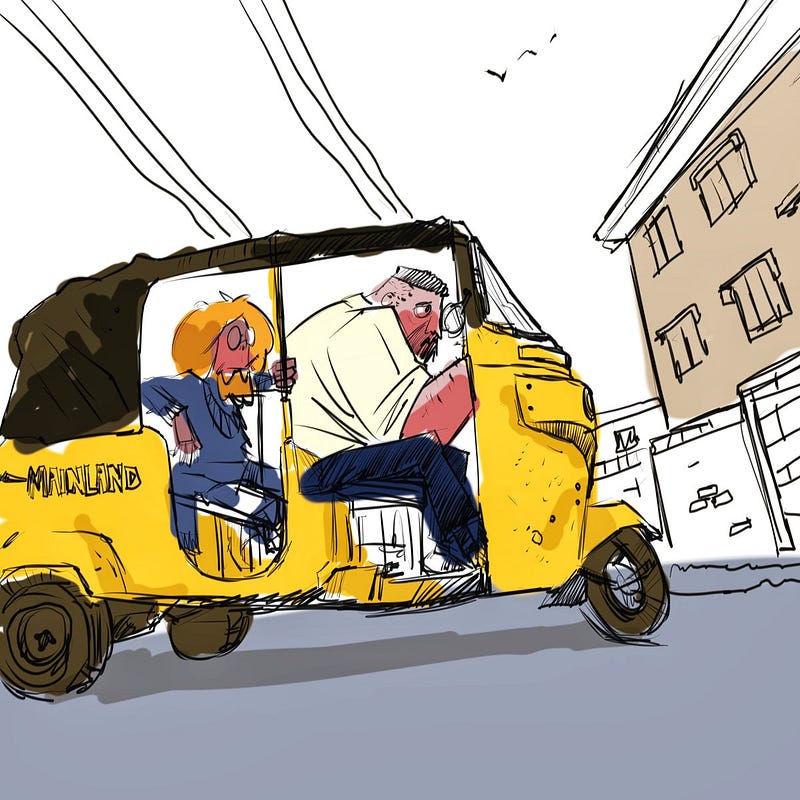
So it was that W.A.S.P. was created, and so it was that we began working on Mainland.
Now, the interesting thing about the planning fallacy is, even if you account for the planning fallacy, you are still liable to fall prey to the planning fallacy. [Say that six times — it’s not a tongue-twister, but it would amuse me].
We are a bunch of ambitious rascals who think we have the right mindset [as well as just enough talent between us] to create a show we’d like to watch. That’s it. At any given time in the creation of Mainland, the one litmus test we use to judge the visuals as well as the script as well as the big idea is: would you watch it? We’re trying to create first for ourselves, not for an abstraction of the quintessential Nigerian.
Back to the planning fallacy thing: making an animated anything is hard. Making an animated show? Tough — you have to plan out the end from the beginning, determine the most economic animation style that doesn’t sabotage your goal, and while you can take pointers from other successful shows, you are largely on your own in the final decision making. We knew this when we started, of course — thank God for that — and so we have been ready to figure out all the schlep. And we have. Sometimes we have been slow, we have been tired, but after resting, we have returned to attack it again with renewed vigor.
So, back to November. In November, we completed a somewhat deep dive into the history of Western [as well as Japanese] pop culture, taking notes and studying their divergences more than their convergences. We have also studied Nigerian pop culture [seemingly shallow, but unearths some insights when you start looking], and it automatically made us better able to make decisions that we’d been mulling over for a long time. Are these decisions good or bad? We don’t know. We just know, now, that we’re not making random decisions. As Morgan Housel said: “a lot of decisions are statistically wrong but intuitively right for the person making them.”
I can live with being statistically wrong. Hey, it’s just show business, right?
We have renewed energy, and can see a clearer picture of the end product, and this is what November has taught me: that you should not compromise on iterating towards clarity. Where anything seems nebulous, step back a second, and get more information. The problem, of course, is that you sometimes don’t know what the information you need should look like, so you let your mind rove for a very long time. All that time thinking about unstructured nothings is beginning to pay off, and I am jumping the gun here by stating that this is a crucial lesson we’ve learned at W.A.S.P.
Please follow this project on Twitter, and if you’re interested in collaborating/sponsoring the show, send me an email: thevunderkind@gmail.com.
Welcome to Mainland.
Tinkerer building while thinking.