You are the Symbiote
Even when you are creating randomly, you really aren’t.
‘Before I came nobody was listening to rap — I made them listen to grammar.’
— MI Abaga
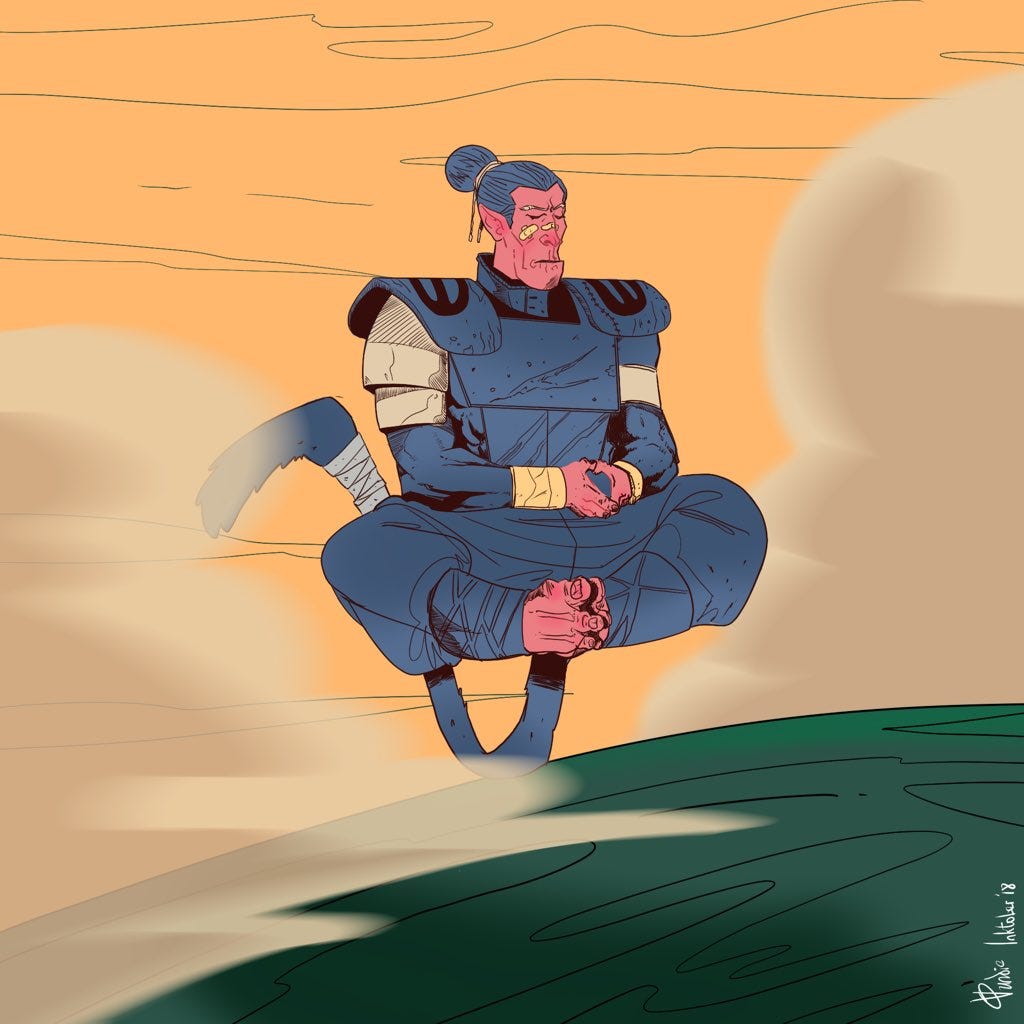
A branch, branching into a branch, into a branch
Introduce yourself as a reader of books to anyone, and you’re almost certain to be asked who your favorite author/what your favorite book is. You are also almost certain to respond with the name of one of the very first books you read, and you’re nearly sure to be unable to explain why that particular book sits on the enviable throne of ‘favorites’.
(If this doesn’t apply to you, no need to dissent — I’m recklessly extrapolating from my personal experience, and arrogantly assuming I am as representative of the world’s population as anyone else [besides, actual professional statisticians constantly obfuscate the math to support their agendas, and I don’t claim to be a better man].)
My theory is that not all creators are created equal, and that they infact come in two forms, namely:
- Audience-acquiring creators, and
- Audience-expanding creators.
All creators, I begin to believe, possess both qualities, but the sort of creator they are overall is a function of which of the above two qualities marks their creative/distribution process.
If I haven’t lost you by now, I’d like to reward you by reifying my point by clearly translating what I mean:
- Audiences do not exist ab initio.
- Creators make audiences.
- Newly-created audiences express affinity to creators distinct from the original creator by a factor large enough to rekindle curiosity, but not large enough to be completely different.
- Point (3) continues in perpetuity until after several generations, we say we’ve arrived at ‘new x’ [new sound, new voices, new styles, etc] — which is really several mutations of the work of the creator in point (2).
There is nothing new under the sun.
Audiences do not exist ab initio
For my entire theory to be true, it is important for ‘audiences’ to not exist in a vacuum. There needs to not be a group of people in the world murmuring among themselves, ‘boy, I sure wish there was someone who could mix clay and salt to give us claysalt art.’
Put another way: demand needs to be absent before supply. Or: supply needs to precede demand. People need to want X because X-makers exist instead of X-makers existing because people want X.
On first glance, it’s easy to see how my theory cannot possibly hold water [or to point out that it’s one of those chicken-and-egg debates for smug unbearded people], and you may bravely suggest that of course musicians exist because people want music, and after all even babies are soothed by the soulful hums of their mothers. You would be right.
True, broad categories of entertainment exist because we’re biologically conditioned to find them desirable. Music, for example. Theater, which begat TV, and so forth. Still, however, the fact that we’re preconditioned to desire a thing does not stamp a final seal on how we react to the thing when it has been created. We like gossip, and have done so since we can remember, but gossip from back in the day bears a different form today [social media and IM], with echoes of the traditional present side by side with it [watercooler conversations].
In other words, while experimenting with hazily established categories, we have broad art/utility forms that we did not perceive as possible, and so could not possibly have wanted them.
Remember the Wright Brothers? On the day that they first successfully flew, nobody noticed, or cared, and nobody noticed or cared for six months afterwards.
The audience does not exist ab initio.
Creators make audiences
Or, put another way, creators make consumers. Electricity, tweets, music, books, fidget spinners.
I mention this because — for creative people at least — one advice creators tend to get is ‘find your audience, and you will succeed.’
I used to think it was a metaphor, but I find that people believe that they need to just create something then ‘plug’ it to the right audience, and success will ensue. This isn’t wrong, by the way, and it marks the perfect segue back to my original categorization of creators.
Audience-acquiring creators are people who can identify an audience and then snatch up as many of them as they can manage. For a pop rock artiste in Nigeria, for example, that person would be one who attempts to identify Nigerians who like Owl City and then target them by emulating Owl City’s vibes and then infusing their own style into it, creating a branch from Lovers Of Owl City Who Are Nigerians (a branch, branching into a branch, into a branch).
Those are the kinds of people who ‘find’ their audiences. The size of their audience [or the ceiling], is necessarily a function of how many of such consumers organically exist and how many of those people they can convert.
Audience-expanding creators have a similar playbook, with a small addition: they expand the general pool of audiences possible, either accidentally or deliberately.
An example: Scott Adams, the creator of Dilbert [a cartoon strip talking about the corporate world] popularized the idea of hybridization of domains [merging two domains/classes of expression/creation to create something new, eg a cartoon strip about the corporate world].
By creating something entirely ‘new’, the audience-expanding creator is not merely repurposing the audience from an already existing pool, but adding hitherto unaffiliated consumers to the pool [like people who were immersed in the corporate world but thought cartoons were ‘for kids’].
As you can already probably guess by now, these categories of creators aren’t mutually exclusive, and creators phase in and out of these categories depending on various factors.
When you’re asked who your favorite ‘x’ is, [and if your favorite ‘x’ is one of the first creators you consumed in the category you’re now immersed in] odds are you are citing an audience-expanding creator.
MAYA (not to be mistaken for MAGA)
Creators are themselves products of context. Everything they create is the outcome of their contextual consumption — of problems, of other creators, of environmental circumstances moderated by innate limitations.
A good creator, then is someone who creates the Most Acceptable Yet Advanced (MAYA) thing to be consumed. It must be advanced enough to be an upgrade on the status quo, while being acceptable/familiar enough to not be out of reach/generate too much friction.
In other words, creators are both a function of how different they are from everyone else and how they are quite like everyone else.
Which leads to this:
Newly-created audiences express affinity to creators distinct from the original creator by a factor large enough to rekindle curiosity, but not large enough to be completely different.
Continuous iteration
Understanding the exact point you inhabit on the ‘creator spectrum’ lets you understand what you should be doing less of/more of to ‘leap’ to the next consumer band. Everything appears random, but it’s randomness with a formula.
I am nowhere near conviction, even of this entire thing — it’s a total mind-dump, and I may cringe a few months after — but it does serve as a framework for thinking about how your audience is thinking, and how you may consider thinking.
Know when you’re acquiring, and expanding, note the attendant friction, and see which is suited for your overall objective [large audience — acquiring strategy, or strong influence — expanding strategy?]
Tinkerer building while thinking.